
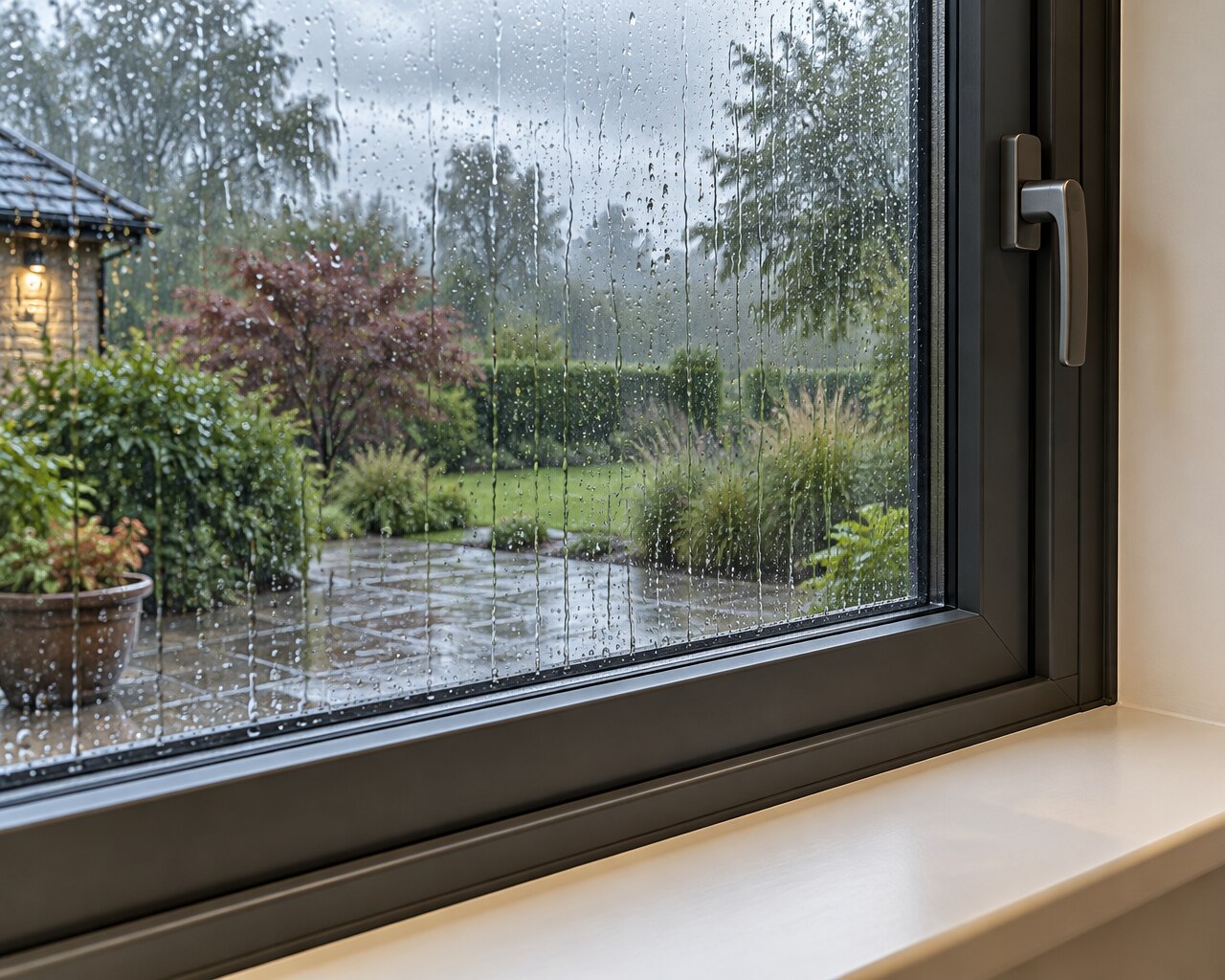
Rain can enter through a window even when the glass is intact: wind pressure pushes water through weak seals, blocked drainage paths, and gaps between the frame and wall. By the end, you will know how the assembly manages water, how to inspect it after a storm, and which specifications reveal whether its performance depends on more than a marketing claim.
Key takeaways
- Check drainage holes and the sill for blocked paths after heavy rain.
- Inspect seals, corners, and locks for leaks or stiffness after a storm.
- Choose windows with tested water resistance, effective drainage, and replaceable seals.
- Allow for temperature-related expansion when checking gaps and window operation.
How a window manages wind-driven rain
Wind-driven rain can travel horizontally through a tiny gap that stays dry during ordinary vertical rainfall. A UPVC window manages that pressure by controlling where water goes, not by making the frame completely impervious.
- Water first meets the outer frame and is directed into the UPVC window frame chambers. These hollow sections reduce the pressure reaching the inner face.
- The welded corner joints keep the frame’s assembled corners closed. A cracked weld or separated joint gives water a direct route towards the room.
- Glazing beads and seals hold the glass against the frame and close the edge gap. A displaced, hardened, or compressed gasket lets rain pass around the glass.
- Any water that enters the outer sections is channelled towards drainage outlets and weep holes, rather than stored inside the frame. Blocked channels raise the water level until it reaches the inner seal.
The locks and handles also matter because they pull the opening sash tightly against its gaskets. A loose adjustment leaves a pressure gap along the meeting edge, especially on sliding sashes and interlocking meeting rails.
Water resistance depends on the complete assembly: frame design, gaskets, glass installation, drainage, perimeter sealant, and the wall connection. Double glazing improves insulation and can reduce condensation, but it does not compensate for a failed seal or poorly sealed installation gap.
A stated test pressure matters too; a window tested at low pressure may not withstand monsoon gusts.
Why drainage holes and the sill matter
Water reaches the room when trapped inside the frame or allowed to bypass the wall connection. Weep holes collect water from the lower frame and discharge it outside; drainage channels lead water toward them. These openings are deliberate, not defects. Keep them clear of paint, plaster, dust, and debris.
A blocked outlet can push water toward the room-side gasket or sill.
- The sill slope sheds water away from the frame. Keep the external seal continuous where the system specifies one, and do not cover the frame’s drainage outlets.
- Flashing directs rain past the wall opening instead of behind the frame. Check flashing indoors and outdoors for gaps, lifted edges, and signs of leakages after plastering or repairs.
- Seal installation gaps between the frame and masonry, including fixing holes, with the specified backer material and sealant. An unsealed perimeter gap lets wind-driven rain bypass a well-tested frame.
A window can manage limited water inside its outer chambers, but it cannot correct a flat sill, cracked external plaster, or missing flashing. Double glazing improves comfort and condensation control; it does not waterproof the wall connection. Drainage works only when outlets remain open and the surrounding installation sheds water outward.
How to inspect a window after a heavy storm
Start a heavy rain window inspection while the surfaces are still wet. Check the exterior sill, sill corners, frame-to-wall joint, glazing bead, and nearby plaster before replacing the glass; water can travel through a frame cavity, sealant gap, or wall void and appear below the actual entry point.
- Look for blocked drainage openings, standing water in the sill, cracked perimeter sealant, and damp marks at interior wall edges.
- Examine rubber gaskets for gaps, flattening, tears, or sections pulled out of their channels.
- On sliding units, clear the sliding tracks and inspect the locks and interlocking meeting rails. Misalignment leaves a direct path for wind-driven rain.
- Check corner welds and the lower frame, where water can collect before reaching leaking walls.
Rain entry and condensation leave different patterns:
| Sign | Rain entry | Condensation |
|---|---|---|
| Location | Begins at a sill, corner, gasket, joint, or wall edge | Forms on the room-facing glass edge, frame, or hardware |
| Pattern | Tracks, pooled water, or a drip that follows gravity | Fine droplets or fog spread across a cold surface |
| Timing | Appears during or soon after rain, especially on the windward side | Returns during humid indoor conditions, even without rain |
| Test | Dry the area and monitor it during the next storm | Improve ventilation and reduce indoor humidity; the moisture should lessen |
Do not dismiss a damp wall because the glass looks dry. Trace the highest damp point and inspect both sides of the frame.
How temperature changes affect seals and operation
Heat and sunlight make UPVC frames expand; cooler weather makes them contract. This UPVC expansion and contraction is small, but a wide frame, dark finish, or large temperature swing can alter frame alignment enough to increase sash friction, change lock engagement, or leave a gasket compressed unevenly.
Opening resistance often rises in hot afternoons or cold mornings, then eases as temperatures settle.
Glass moves too: insulated glass units warm in direct sun and cool after sunset, while the frame changes around them. The glazing must remain supported without stressing its edge seal.
A gasket that has become brittle, detached, permanently flattened, or swollen cannot follow this movement, so water finds a path even when the glass is intact.
Building movement adds a separate strain. Settlement, vibration, or expansion at the wall can pull a perimeter joint away from masonry. Sealant needs adequate sealant movement capacity and a clean, dry, correctly sized joint; a thick bead over dusty masonry is not a durable repair.
Check operation across weather, not only on a mild day:
- Confirm the sash opens without scraping and the handle reaches its locked position.
- Inspect gaskets for gaps, cracks, flattening, or corners pulling loose.
- Look for a separated sealant line at frame-to-wall joints, especially near corners and the sill.
What to compare before choosing a rain-resistant window
Compare the complete tested window, not a claim that the profile is “waterproof.” Sliding versus casement windows involves a trade-off: sliding sashes have overlapping rails and tracks that need clean drainage and precise seals, while casements usually offer fewer direct rain-entry paths.
Fixed and tilt-and-turn windows suit different needs: fixed units remove opening gaps, while tilt-and-turn hardware adds ventilation but demands correct adjustment.
| Option | Rain-entry trade-off | What to compare |
|---|---|---|
| Sliding | Tracks, meeting rails and interlocks create more drainage and sealing points | Track drainage, weather seals and adjustment |
| Casement | Compression seals close tightly against the frame | Gasket continuity, hinges and locking points |
| Fixed | No opening sash means the fewest moving entry paths | Perimeter seal, glazing bead and installation joint |
| Tilt-and-turn | Strong compression when shut; complex hardware needs alignment | Locking cams, hinges and gasket contact |
| Aluminium | Frame performance depends on thermal breaks, seals and drainage design | Aluminium window rain protection, sill outlets and the tested assembly |
Request evidence that names the complete configuration:
- Profile chamber count, glass thickness, gasket material and hardware quality.
- Window size, opening type, glazing, drainage arrangement and installation method.
- A water-penetration test showing the applicable standard and test pressure or pressure class.
- A sill detail showing outward slope, unblocked drainage outlets and the frame-to-wall seal.
If you are considering a sliding window from Nutec International, request that same test configuration rather than accepting a profile specification alone. A result for one size or glazing package does not prove identical performance for another.
Related product
 | UPVC Doors and Windows - *Space-saving*: Perfect for small rooms or tight spaces - *Low maintenance*: No painting or polishing needed - *Energy-efficient*: Keeps your home... View product → |
Frequently asked questions
How does a window manage wind-driven rain?
It uses seals, overlapping frame sections, drainage paths, and sill channels to redirect water outside instead of relying on an completely impervious frame.
Why do drainage holes and the sill matter?
Drainage holes let water collected inside the frame escape, while the sill directs it away from the wall. Blockages can cause water to back up indoors.
How should you inspect a window after a heavy storm?
Check the room-side edges, corners, seals, locks, sill, and drainage holes. Look for dampness, staining, trapped water, blocked openings, or difficult operation.
How do temperature changes affect window seals and operation?
Frame materials and seals expand and contract with temperature. This can alter compression, create stiffness, or expose gaps when components are poorly fitted or worn.
What should you compare before choosing a rain-resistant window?
Compare water-resistance test results, frame drainage design, seal quality, sill details, hardware adjustment, installation method, and replacement support.